
By Andrew Sharp
Gunpowder Trails is a serial novel, debuting with Chapter 1 in November 2015 and slated for release chapter by chapter over the coming months.
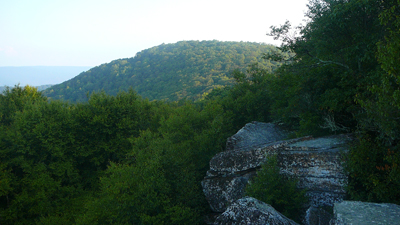
A band of travelers picked its way over the stones down the mountainside toward the lower hills and the river valley beyond. If humans still knew how to fly, a pilot looking down would have had a hard time picking out the line of travelers in brown fringed deerskin. From above, they were only a flicker of movement through the canopy of spreading branches that blanketed the mountains.
These particular travelers were a group of smugglers. In a few centuries, these smugglers would lose their weary droop. Their flea-infested beards would appear dashing, their bad manners be transformed into free-spirited revelry, and the greed that drove them become bravery. Their unwashed stink would be long ago washed away by time. These newly anointed merry men would defy oppressive rulers and become the heroes of song. But as the slave Charles trudged down the mountain trail, he was surrounded by smugglers who were very present day and only a few feet away. He was not inclined to frame them in song.
These heroes were surly, with blisters and aching joints, reeking of campfire smoke and sweat and life on the trail, and complaining about the mosquitoes whining in their ears.
Charles did not have to worry about their taking out their surliness on him, despite his lowly status as slave, because he was enslaved to George, the chief smuggler. The smugglers maintained a strong independent spirit, but they knew better than to bring the wrath of George down on themselves without a very good reason.
George led the line now, a few steps ahead of Charles. He looked almost out of place, despite his mountaineer garb. His face was nattily clean shaven, the only such face in the band, and it wore a boyish innocent expression that often took in strangers. The band knew better.
Just behind Charles were George’s lieutenants, an informal council that backed his authority and offered advice George sometimes listened to.
James and John, the twins, were easy to tell apart once you knew them. They both wore their dark, straight hair long, but John was a little thinner and forked his beard into braids to accentuate his swagger. If his bravado led him into tight situations at times, he had a genius at getting out of them that had secured his place as a leader in the band.
James, shorter and more stocky, eschewed any buccaneer style but shared his brother’s thirst for profit and added charisma and an ability to persuade that helped George a great deal in maintaining order.
Just behind them trailed the last two of George’s informal cabinet; Warren, whose hair was beginning to gray but who could still hold his own in a fight, and Big John, who stood barely five feet tall, had a fierce temper and could shoot a bow better than anyone in the band.
Warren had joined the gang not long ago and nobody was sure exactly what his story was, but they had the impression his farm had failed, or been seized, or that he was in some other kind of disgrace. It was a common enough story, and in a smuggling band there were many who preferred not to discuss the past.
Behind the leaders straggled the rest, about sixty in all, mostly men but a handful of women. The women took an equal share of the danger and the profits, except of course for Marguerite, Old Harry’s slave, who got none of the profits, carried little, and marched along in stony silence most of the time. The other women avoided her.
Ahead, in the river valley, the tree canopy began to break up and trails of smoke rose out of clearings. Beyond these outposts, the trees thinned out into hedges marking out a patchwork of wheat and corn, and scattered clumps that offered shade for herds of cows and goats. Surrounded by these farms, still out of sight of the smugglers, lofty stone walls and towers rose out of the sea of crops. Scranton, the powerful city state that dominated the surrounding miles of villages and farms, was the smugglers’ destination. Or rather, it was the point they would orbit around, lurking in the border forests.
Charles was glad this was his last trip to Scranton, despite its grandeur. Since George had bought him, Charles had marked two trips every summer, and George had promised Charles his freedom if he would serve well for 15 trips. Now as he approached his 20th year, that long awaited fifteenth journey was half over. The miles on this trip had been much longer than they had been on previous ones.
He was one of only a few slaves. There was Marguerite, who had a very different relationship to her master than Charles did to his, and Gary, John’s slave, who ingratiated himself with his master and presented himself as a superior smuggler-in-training around the other slaves.
The smuggling life did not lend itself to slavery. If slaves were poorly treated or were unhappy with their captivity and ran away, they could expose the group’s secrets and get a number of them hanged before the smugglers managed to track them down and kill them. It was better, almost a necessity, for smugglers to be volunteers. Those slaves the smugglers did keep were usually treated very well and given their freedom after a specified time of service.
The packs they all carried were filled with tobacco, which Charles’ homeland produced in abundance. What it did not produce was sulfur.
Sulfur was used to make gunpowder. Gunpowder was used to manufacture power. Power sold very well on the open market, and for this band, the exchange rates from sulfur to power provided an excellent living. The luxury afforded by that profit made it worthwhile to defy the strict rules on sulfur trade and risk torture, hanging or beheading, depending on which jurisdiction they might end up getting careless in.
The smugglers who lived long enough to enjoy their profits were, in addition to being lucky, careful and skillful. They could hit what they shot at with bow or gun, track game or enemies, blend in with the woods, read the weather, hike for many miles and run a great distance over rough terrain when the need arose.
Charles recalled with bitterness the tales of pirates, outlaws and smugglers he had devoured as a child. During the thousands of hours he served as a human mule, slipping on rain-slicked stones, maneuvering around fallen logs, and putting one weary foot in front of the other over and over and over and over again, he had often reflected on these stories. They had left out many details, like how all your muscles were sore and stiff in the mornings, and the constant drip of rain down your collar during a storm, the sharp hunger pains when game was scarce or the hunters missed their shots, the constant prickle and itch of bug bites. And always, in the shadows, the cats.
Had he joined the smugglers out of greed or a longing for adventure, he might have become disillusioned, but his motives were not an important factor in his life. He was only a toddler when he had been made a slave.
From what he gathered from snatches of conversation, combined with his knowledge of politics and the current news, he had constructed the outlines of his story: An invading army from Easton had failed to take the city of Salisbury during one of the later tobacco wars, but while it was leaving it had plundered the countryside and captured a number of residents for slaves, including him.
He did not know who his parents were, what they had done for a living, if they were in fact living or had been part of the charcoal landscape left behind by the Eastons. Perhaps they, too, were now slaves, although even in a city the size of Easton he knew most of the faces and was fairly sure none of them belonged to his parents.
Or maybe he had been an orphan, even in Salisbury, and his caretakers had fled and left him to his fate.
He had wondered about his past often when he was younger, but there were no answers and by now he was tired of speculating. Although he knew it wasn’t fair, he was angry and hurt that no one had come to get him, that apparently neither his parents or anyone else in his old country had missed him. Sometimes, during times of peace, delegations would come and exchange their captives for Easton slaves and take them back home. Nobody had come for him.
For some reason, George, the smuggler posing as a respectable slave trader, had bought Charles when he was about twelve. He had never known his exact age, but it was in the year they called him twelve that he had become George’s property. Why a smuggler had decided to purchase an undersized, awkward and quiet boy with hunched shoulders and no strength for hauling goods, was information Charles had never worked up to asking for and had never been told.
Despite Charles’ frailty, George had introduced him to his real trade in the form of a seven hundred-mile round trip through empty and savage wilderness. The twelve-year-old Charles could not carry a pack that first journey; it was all he could do just to walk the mountain trails with his small legs made soft from city life. He served as a personal assistant to George, learning to gather firewood and then to start the fire in the morning, to cook, butcher game, and do anything else that was necessary but that George did not feel like doing.
On following trips George gave Charles a small pack to carry, along with his other duties, and his legs and shoulders strengthened but remained weaker than the others . His packs got larger, but never quite so large as those carried by the rest. On the trail, strength and ability were status, and he was doomed to the bottom of the scale.
The journey to Scranton was about 300 miles, and the men could walk about 20 miles a day when they had food and the weather was good, so in theory they faced only about two weeks of pure walking. But with all the extra time spent finding food and navigating around dropoffs and gullies and fallen trees, weathering out storms and fending off predators or disease, the journey to Scranton and back took about two or three months total.
Every spring the smugglers would drift back together, one at a time coming into the pub to buy a beer for George and have a quiet conversation in the corner about terms. Sometimes a new one would come, sent by this person or that one who knew where they could get a job and make some real money this summer, and George would ask a lot of questions and size up their physical strength.
After such a talk, which did not, Charles had been told, present a very rosy picture of the smuggling life, many of the candidates shook George’s hand and walked out of the pub and did not come to the rendezvous boats when it came time to leave. But enough always did, thirty familiar faces and five or six new ones this year, fifty old hands and ten new ones that year, ready to evade the overstretched navy patrols, cross the bay and head up into the mountains.
If the smugglers left many new piles of stones along the trail during the spring trip, George would have to take more time to interview new volunteers for the fall journey. Almost always, there were enough to make a second run. Some smugglers always did the spring trip, then left to attend to business, while others planted an early crop and then would show up at the boats in the late summer, shaking hands and pounding old friends on the back.
Each winter when the sulfur had been transformed into piles of cash, divided evenly, the smugglers would drift off again to their own huts or shops or farms. Most of them did their best to spend all their money by spring, frequently with great success.
Before spending their money, though, they had to earn it.
The first half of this trip wrapping up, Charles already dreaded the second half when, with packs straining at the seams with sulfur, they would walk back up into the mountains to repeat the steps they had just taken. Every downhill would now be an uphill, and Charles remembered many long steep drops down across streams and then back up to the ridge tops. And this time, they would be carrying valuable contraband that any mountain people they came across would be delighted to take off their hands. Nighttime raids were not common, mostly because the Appalachies themselves were not common, but living through even one or two left a smuggler sleeping uneasily and lightly in mountain camps.
The Appalachies had old rusty firearms that they preferred to bows. These they kept supplied with gunpowder made from stolen sulfur. If the sulfur were unattended, they were happy to take it to a new home where it would be better looked after; if it were attended, they did not mind slitting the throat of the attendant to silence his objections. Had the Appalachies been numerous, the gunpowder trails would have been abandoned to grow up in honeysuckle, but thankfully for the smugglers they seemed to mostly live alone or in small family groups, and their moonshine intake kept them from being as formidable as they might have been. According to popular belief, they were rendered even more ineffective by inbreeding.
Before the smugglers ran the gauntlet of the Appalachies and the beasts of the mountains, though, they had to get the sulfur in the first place. In Scranton, the hub of the illicit sulfur trade in the East, death by torture was only ever a mistake away. The authorities were eager to make an example of any sulfur smugglers they caught, and were very practiced at it.
So far, the trip had been uneventful. Not one man had disappeared in the woods while hunting, or gone to get water and not come back.
Since they had left Easton Charles had harbored the suspicion that fate, or God, whichever was in control, would make this last visit to Scranton the one he would be caught. It would be typical of his life. Everything had always been snatched from him — his parents, his education, and now, why not his head?
Should he keep his head, he certainly would not risk it on any more smuggling. He wasn’t sure what he would do instead, but he wanted it to involve as few visits from these grimy criminals as possible.
The afternoon siesta over, Charles hiked in his usual post-nap haze, hating the trail even more than usual. His lunch still heavy on his stomach, his head foggy, the last thing he wanted to do was hoist a heavy pack up to strain at his sore shoulders and press down on his bruised hips. As he walked, though, the cobwebs began to melt from his mind and his muscles worked out their stiffness.
The August heat puddled near the ground, with no breeze to stir it up, and the hot stones burned through Charles’ thin leather shoes. Sweat dripped down to redampen the shirt that had dried and stiffened during lunch. For the last several weeks he had endured a massive heat rash, and despite the thick calluses on his feet, he thought he could feel a blister forming. Blister or no, the sharp stones took their bruising toll as well and Charles tried to let his mind wander and not focus on the pain that shot through his feet with each step.
The band had been climbing and descending all morning, but as the trail left the mountain ridgetop they walked more downhill than up. They were now on the last major downhill slope, following a long ravine that stretched a couple of miles ahead of them before they reached the first villages and farms on the outskirts of Scranton.
Scranton itself was a barely discernible smoke haze in the distance. It was hard to tell if the haze was just a dark cloud, or the smoke from Scranton’s many forges where blacksmiths crafted the weapons and tools for the region from metal salvaged from the vast fallen cities.
The smugglers would not visit Scranton as a band, of course. Tomorrow, two or three of them would walk into the city dressed as farmers, or miners on holiday, and pay a visit to Jeff, the man who never sold sulfur but was happy to pass on messages. Jeff did a thriving trade in tobacco, which he bought from merchants who always seemed to know where to get it. After they talked to Jeff, traders would arrive at the smugglers’ camp, carrying the noxious-smelling bags of sulfur for bargaining.
That rendezvous camp was today’s destination. Each trip the camp was in a different spot, somewhere in the woods near the first farms, but far enough away to avoid hunters or patrols. George would select a defensible site with plenty of water. He preferred plenty of boulders and a good clear view through the woods.
The band did have a couple of permanent hideouts, but Charles had never seen one and hoped he never would. These dark abandoned mines and old caves were for survival only, dark tunnels leading deep underground where the smugglers could disappear if someone alerted the government to their presence. There, they could wait until the search died away, with entrances blocked off to keep soldiers from noticing the opening and predators from following them in.
Once in a while, old veterans like Old Harry, and the twins, James and John, would loosen up when they were drunk and tell about surprise raids that had decimated the band, when they had fled through streams to keep their scent from the bloodhounds and many good smugglers had been taken back to town to be hung from the walls.
“I’ll never forget the sound of those bloodhounds,” Old Harry, a balding, paunchy man, would say on these occasions in his deep bass voice, slightly raspy from the cigarettes he smoked all day. “Thought that was the end of the trail for me” — Charles thought he caught regret on Marguerite’s face when he would say this — “It was the end for a lot of those old bastards.”
It was better, they said, since George had taken over, and Charles knew this wasn’t just flattery. Everyone said there had been no real disasters since George had taken over. He was careful. And lucky. A good leader must have both traits. Luck, the smugglers said, was something you just had, or you didn’t. When a leader’s luck ran out, he had better get it back in a hurry. Less drama, and more profit, was the way the smugglers liked it.
As the band made its way down into the lowlands, where roads and farms would soon begin to cut across their route, George turned quiet and irritable as he always did. Here, there was the risk of patrols of Scranton soldiers, or nosy and loudmouthed travelers who would make full reports on their arrival in town. George believed in making his own luck. And when George was careful, everyone else was very careful to be careful.
“I’m out of water,” Warren said.
“Me too,” Big John said. “Think I’ll drop down into the ravine and fill up from the creek.”
George nodded and stopped. Big John and Warren and a few others turned downhill, swinging their empty canteens.
George rested on his walking stick, staring down the valley toward the smoke of the city, which rose straight up. Gnats danced around Charles’ head, and a bead of sweat trickled down his face and ran down inside his shirt.
Shouting from the ravine interrupted the stillness, and the resting band members stiffened and peered down the hill toward the noise. Then Big John came running through the trees, water slopping from his open canteen. He was alone.
Now another yell came out of the ravine, this time a long and sustained one, of many voices, as out of place as thunder on a sunny day. A line of steel-clad men rose out of the ravine before the smugglers’ incredulous eyes, a wall of soldiers stretching out ahead of them down the ravine and behind them the way the smugglers had come. Some soldiers knelt and aimed guns. Others pointed crossbows and drew longbows.
Caught without their weapons ready, the smugglers dodged and scattered as arrows zipped past or whacked into trees. A few arrows found their marks with a whack and smugglers toppled onto the ground.
Flashes of fire and a wall of smoke came from the line of armored troops. Bullets slapped the bark around Charles and more smugglers staggered and dropped.
It had only been a few seconds since Big John had come shouting back, but it seemed to Charles that bodies were heaped everywhere along the trail.
“Run!” George shouted. His command was not necessary. The smugglers were already wrenching their packs on and stumbling through the trees under the burden. Several of the packs now bristled with arrows meant for the smugglers’ backs. Bullets and arrows kept whistling into the trees, chased by the thunder of the guns. Several more smugglers fell, but not as many, as the soldiers began to have trouble finding a target in the confused brown forms running in the smoke.
Charles tried to run but had trouble picking up his feet, which felt heavy as stones. Expecting to be struck with a bullet or arrow any moment, he forced his feet as fast as they would go, feeling that if he stumbled, it was all over. He noticed tiny irrelevant details on the forest floor as he ran — a clump of mushrooms like purple umbrellas, their delicate edges paper thin. A foxhole under the roots of a hickory tree, pebbles dotting the fresh earth at its entrance. Charles leaped over a rotting log and kept running, his chest starting to burn. Somewhere behind him, people were screaming. Then it happened — a sharp blow on his back almost sent him sprawling onto his face before he caught himself.
I knew I would get killed this trip, he thought bitterly. And then he remembered that he was wearing his pack. He felt no pain as he ran, except in his lungs and knees, so he hoped his pack had caught an arrow and not a bullet. He recalled hearing smugglers talk about not noticing wounds until later, so he wondered hazily if he had been shot through the lungs and was about to keel over dead. He patted his chest and stole a glance at his fingers as he kept running. Dry.
One of the fleeing men, he couldn’t see who, stopped behind a tree nearby, drew his bow, and fired back toward the pursuers. Charles ran on. Other smugglers began to do the same. Stop, shoot, and run some more. Some pulled out their six-shooters, aimed swiftly, fired, and then ran on. Guns were only for absolute emergencies; this qualified. Since the troops had fired first, the smugglers had no need to avoid the sound of gunfire and the attention it would bring. And it was better to lose valuable gunpowder than your life.
Charles pulled out his own pistol and jumped behind a tree. Peering out, he winced in anticipation of a bullet to the face which did not come, and saw several hesitating troops about 50 yards away, pointing guns uncertainly in one direction, then another. One of them went down. The other one raised his gun toward Charles, so Charles shot at him. Without waiting to see the result, he spun and ran on. He had to step around the body of a smuggler sprawled awkwardly over a tree root, blood dripping out of its hair and puddling in the leaves.
Behind Charles, voices urged soldiers forward. He pushed himself to keep running for a long time, deeper into the woods, hearing the gunfire continue on and on, scattered now, a shot, then another, now two, now a quick string of shots. Pause. Another shot, two more. An arrow buried itself in the leaves about twenty feet from him.
As far as Charles was concerned, the battle phase was over after his one shot, and he set his mind only on getting away. He didn’t care if the band survived or not, as long as he did. He disliked most of them.
After a short heaving rest behind a pile of fallen trees, he heard footsteps crashing and he scrambled to his feet and plunged on, dragging his numb legs along. Automatically, he kept the late afternoon sun slightly ahead and to his right, where it had been when he first ran from the ambush. Always travel in a straight line, and you’ll know where you are. He passed through a thicket of young saplings growing in a fire-burned clearing, ripped through a raspberry patch, dodged through mature oaks. He squished through soft and damp moss under a grove of hemlocks and clambered up a hill piled with gray boulders, painfully aware that he was exposed out in the open, his back tensing for the bullet. Over the crest of the hill, he pushed through a rhododendron thicket in a long valley, then splashed through a stream. His vision grew dark around the edges. The ground heaved and tilted, then rushed toward him.
When he opened his eyes, the sun was a little lower in the trees, and his tongue was dry and felt swollen. He took off his pack and crawled to the stream, where the mud and silt had settled back down into his footprints. He sucked in water, stopped for breath, and drank some more. Then he sat up and looked around.
A tulip poplar leaf came drifting down and landed on the stream, spinning slowly around and carried away in the current to get caught in a jam of sticks. Tulip poplars were the first to drop their leaves. Fall was coming.
Far off, he heard a crashing noise, and scrambled to find his pistol. It was lying where he had fallen. He blew some dirt out of the muzzle and pulled the hammer back. The noise came nearer, and he peered to see movement. There it was — a brown figure in deerskin. He waved both arms. Better not to surprise a frightened man with a weapon at close range.
The figure lifted a hand. He saw now it was George, trudging along with his bow dangling in one hand. He had lost his hat and his hair was clumped over one ear and oozing red. He only had two arrows left, Charles noticed. Without saying anything, master and slave moved on together.
Had the band not been so experienced, it would have taken them days to find each other again, but they were all used to navigating in the forest and had a prearranged plan for disasters like this. All of them knew to keep running straight away from any attack, if possible, until the danger was gone, then hike about a half hour further. That would leave them all in the same area, although the area might be a large one.
If they could not find each other, they would have to face the night in the wilderness alone.
The soldiers had relied on surprise to wipe out the smugglers. Once they had made the most of their attack, they would be reluctant to track experienced woodsmen through the trees into a headwind of arrows. The soldiers were well aware of the smugglers’ outsized reputation. After a short pursuit, they had likely hustled back toward civilization before darkness fell.
As he followed George, Charles wondered how many smugglers were left. He remembered seeing bodies strewn everywhere. If only a handful of the group had survived, they would have to abandon the expedition and try to make it back to Easton empty-handed before winter, probably even leaving their tobacco behind. Charles pondered whether George would count a failed trip like this as one of his fifteen. He doubted it, and misery settled on him.
After about forty-five minutes of hiking, George stopped and listened. Then he put his fingers to his mouth and whistled, a clear sharp series of bobwhite calls that would carry a long way in the quiet woods. Charles winced, thinking of the soldiers, but reassured himself that they were almost certainly out of earshot. It was a risk they had to take.
Not far away, two other whistles sounded.
The group grew larger a few at a time, as more and more weary smugglers came to the whistling call that was repeated every few minutes. They dropped their packs and slumped down to rest, backs against trees or leaning back against their packs. Some of them wrapped up wounds, or had friends help them.
After a while, George had Charles and a few others gather dead limbs for a fire. As a precaution he sent several men back in the direction of the ambush to look out for any pursuit.
The wood gatherers made a tall stack of limbs, and Charles started a fire with a flint and began building it up, tossing on handfuls of dry leaves that climbed into the air in a heavy gray column. As the plume rose over the trees, more smugglers began to make their way in, a few with ugly wounds and arms dangling uselessly, or one leg dragging. One man still had an arrow through his shoulder, a dark spot seeping out through his buckskin shirt and more blood dripping down his ankle.
As for those who were still alive, but hurt too badly to travel, there was no time to search for them before dark. They would have to lie in the darkness alone, the smell of their blood spreading far away and drawing in the cats. If they were able to build a fire, they might survive.
Apparently Charles’ panicked mind had piled up an excess of bodies, because only about twenty of the sixty smugglers were missing. A few more looked like they might not last long, including the man with the arrow through his shoulder, who was biting down on a stick now and writhing as another man tried to work the arrow out of his shoulder bone.
Still, the smugglers had lost this fight, and badly. Although even a kingdom the size of Scranton would miss the soldiers who had died, its army could spare a handful of losses better than the smugglers could. The band had lost not only about a third of its number, but the tobacco those men had been carrying, the profits from the sulfur they could have hauled, a great many arrows and bullets, and a lot of valuable gunpowder.
George and his lieutenants conferred in a huddle near where Charles was feeding more wood into the fire. Most of them were there. James and John had made it unscratched. Charles was surprised to see Warren, with his usual unruffled calm, binding up a nasty cut on his elbow. When Big John had come running back from the ambush, Warren hadn’t been with him. Charles wondered how he had gotten back. He looked around for Big John, but didn’t see him. Charles strained to remember whether he had seen him go down. He wasn’t sure. All he could remember were bodies and gunfire and mushrooms and fallen logs and that nasty sound of projectiles passing nearby, and the shooting pain in his legs and lungs.
George’s face was white and his mouth was set. His surviving lieutenants wore the concerned expressions of men who were pondering that any of them could be given credit for the disaster.
“That was a whole damn division!” George said. “Where the hell did a whole division come from?” His voice rose. “And how did they know where we were going to be?”
His subordinates glanced at each other.
John offered, “Maybe they didn’t know. Could have been a patrol. Maybe somebody saw the smoke from our campfire and a patrol was in the area and came over to check it out.”
“A whole division out on patrol,” George said. “Just out strolling around armed to the teeth, and they stumbled across that ravine and thought they would sit down and have a picnic lunch. And then we came along.”
“But if it wasn’t just a patrol, how did they known where we were?” James said.
“That is just exactly what I was wondering,” George said. “That very question had come into my mind.”
The group pondered some more.
Warren, the oldest of the leaders, had an inoffensive way of staying unruffled during George’s storms. He now suggested one of their contacts must have turned them in. “That, or the government has been keeping more of an eye on us than we thought,” he said.
“Whatever it was, we have to find out, or we’ll walk into another one,” George said. “We’ll do some sniffing around when we sneak into town.”
John blinked. “So we’re still on for the sulfur?”
“We are very much still on for the sulfur,” George said. “I didn’t walk all this way for the hell of it.”
“But if they’re tracking us,” John began.
George cut him off. “That’s a risk we’re going to have to take. We’ll do the disguises, like usual. It’s all we can do.”
“I don’t like it,” Warren said a little recklessly. “Maybe we should cut our losses until things settle down. Or, just trade our tobacco openly. For steel or tools or something.”
George looked at him contemptuously. “Carry a load of steel all the way over those mountains when a peasant can paddle across the bay and pick up a load in an afternoon.”
Such a peasant would have to be unusually hardy and a very good paddler as well, but nobody pointed this out.
Warren shrugged. “Better than nothing.”
“No,” George said. “We don’t need tools from Scranton. Our blacksmiths at home are making better ones all the time, and selling them for cheap. We came for sulfur, we’re getting sulfur. At least, unless we find out the whole network is blown. But if we just leave and come back next spring, we might walk right back into the same trap. There’s not an unlimited supply of people that want to get into this business.”
The scouts came back now and reported there was no apparent pursuit. The sun was sliding down through the trees now, and the forest grew quiet as the light rapidly dimmed. The smugglers stopped cleaning their guns and repairing damaged packs, and pitched in with the fires, dragging in dead wood and heaping it up in large piles arranged in a broad circle big enough for the whole band to fit inside. They lit the piles and a circle of flame darkened the twilight shadows beyond. Then the group brought in more stacks of wood, reserves for the sentries to feed the fires with during the night.
If stealthy pursuers were still tracking the band, the flames would give the smugglers away, but they had little to worry about now. If their enemies were foolhardy enough to go creeping through the forest in the dark, they deserved what they got.
Occasionally, the smugglers whistled or called for any stragglers, but none came.
As the trees melted into the darkness, the crickets and cicadas began their rhythmic rasping, a lulling, peaceful chorus. Charles lay wide awake, his head propped up awkwardly on his pack, surrounded by the dark shapes of the other men sprawled next to their packs in the firelight. He stared out into the darkness, past the flickering flames licking over the beds of coals and the slouching outlines of the sentries, out beyond into the deepening blackness.
The blackness was not empty. Feline eyes stared back at Charles, flickered, circled, disappeared, and returned. He thought he heard a dim wail far in the distance, and a snarling and yowling.
© 2015 by The Sacred Cow magazine. All rights reserved.
 sacredcowmagazine.com